

Dermal filler is one of the most popular treatments in aesthetic medicine — and when it’s placed well, it’s beautiful. But complications happen more often than the industry likes to admit. Vascular occlusion after nose filler: signs, timing and what to do.

If you’re reading this because something feels wrong after a filler appointment — a lump that won’t settle, a lip that’s drifted, a face that stopped looking like yours — you’re not imagining it, and you’re far from alone. Many people live with that quiet “something is off” feeling for months or years before anyone actually looks. The most important thing you can do is get an accurate diagnosis. And an accurate diagnosis starts with actually seeing what’s going on under the skin.
At PH Med, every complication workup begins with diagnostic ultrasound. Dr. Bui is a physician who has spent her career making clinical decisions from imaging — across different disciplines of medicine and thousands of cases. That matters for complications specifically, because the difference between “massage it and wait,” “dissolve it precisely,” and “you need to be seen by a specialist today” is invisible from the surface.
Filler that has shifted beyond where it was placed — or simply accumulated across too many appointments — is the complication we see most. Lips develop a shelf above the border. Under-eye filler turns puffy in photos. Cheeks read heavy instead of lifted. Sometimes it’s product placed years ago that never fully resorbed and slowly drifted; on ultrasound, we routinely find filler patients were told would be “long gone.”
Why it happens: product placed in the wrong tissue plane, too much volume for the anatomy, repeated layering over old product, or simply time and muscle movement doing what they do.
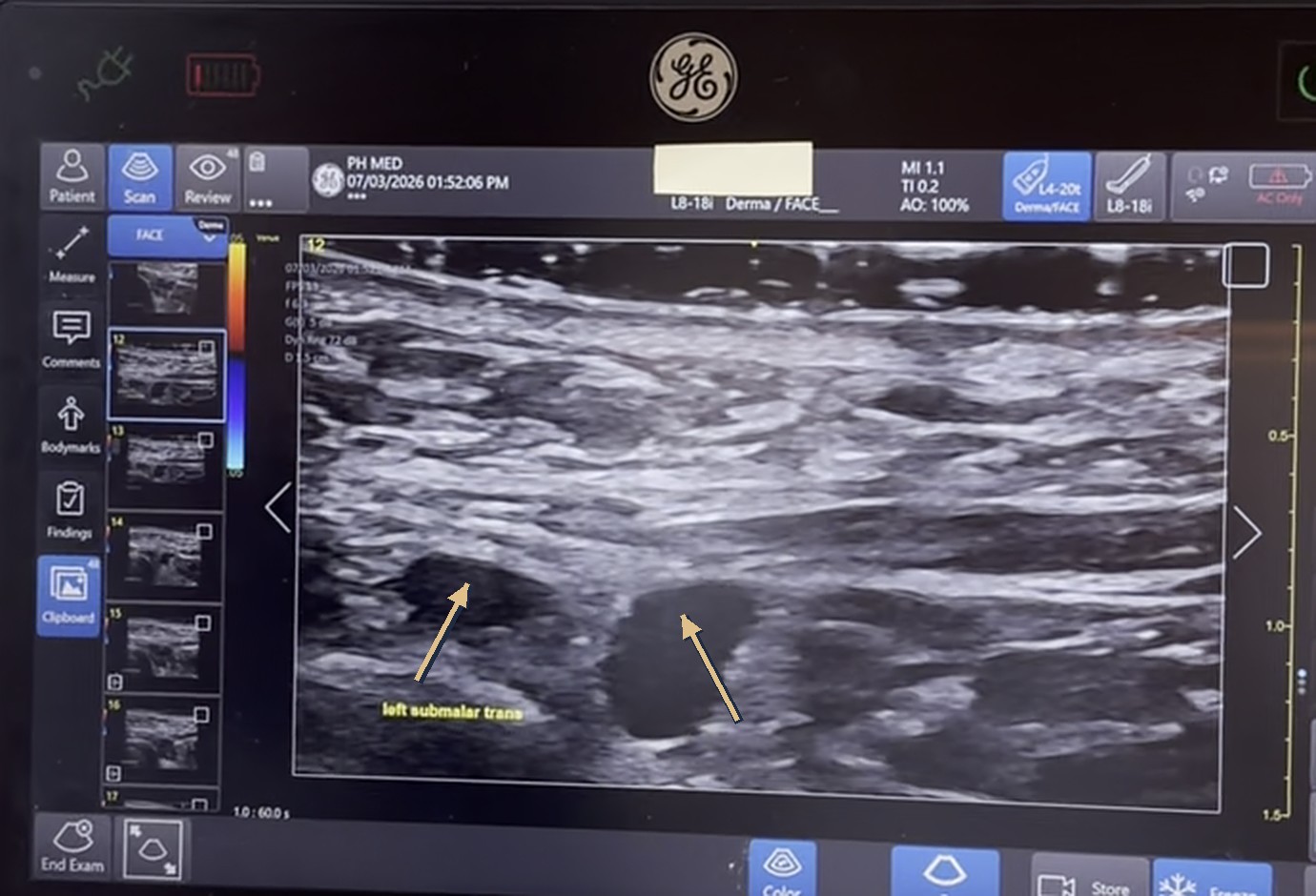
At PH Med: treated in-house. Image-guided dissolution and staged re-treatment are core services here. Non-HA fillers (like silicone or older permanent products) can’t be dissolved with hyaluronidase — if we find those on the scan, we’ll tell you honestly and provide a referral to the right surgical specialist.
A firm spot you can feel (or see) weeks to months after filler has several very different causes — and they are treated in completely different ways. That’s exactly why “just massage it” is not a plan. Early lumps are often simple product clumping or swelling. Later, firm nodules can be filler that’s walled off, low-grade inflammation around product, or — less commonly — a biofilm (a smoldering, hard-to-detect infection around the filler).

At PH Med: diagnosed and, in most cases, treated in-house. When a nodule needs excision, biopsy, or long-course infection management, we refer out to the appropriate specialist — dermatopathology, plastic surgery, infectious disease — and you arrive at that appointment with a complete imaging workup instead of starting from zero.
Rarely, filler enters or compresses a blood vessel and blocks blood flow to the skin. This is the complication every injector should fear and every patient should be able to recognize. Warning signs include pain out of proportion to a normal appointment, blanching (skin turning white), a dusky, net-like or bruised discoloration spreading in the hours afterward, or skin that looks like it’s breaking down in the days following treatment.
How we place filler in the first place — dermal fillers, guided by imaging.If you believe you are experiencing a medical emergency, call 911 or seek emergency care immediately.
Any change in vision after a filler injection is exactly that kind of emergency — go to the emergency room immediately, do not wait for a callback from anyone.
For concerning skin changes without vision symptoms: contact your injector immediately — time matters with suspected occlusions. If you need help understanding what you’re seeing, you can call or text us at (713) 396-2431.
At PH Med: our role here is education and evaluation. Vision involvement belongs in the emergency room — that guidance never changes, no matter who placed your filler. For concerning skin changes after an injection, the safest first move is contacting your injector immediately; if you’re unsure about what you’re seeing or how an area is healing, an ultrasound evaluation can clarify what’s going on beneath the surface and help inform next steps with the right specialists.
A complication consult at PH Med ends in one of three ways — and we’ll tell you which one, plainly, before you leave the room:
Either way, you leave with the same two things: a diagnosis you can see on a screen, and a written plan. If that plan lives with another specialist, your imaging and notes travel with you, and we follow up after.
Yes — a large share of our dissolution work is correcting product placed elsewhere, including filler placed years ago. The ultrasound shows us what’s there even without records — but the more history you can provide, the better. Knowing the type of filler, how much was placed, and when helps us plan the safest, most precise correction.
Yes — hyaluronidase dissolves natural hyaluronic acid too, but the effect is temporary. The enzyme acts as a catalyst that breaks down both the injected filler and your body’s native hyaluronic acid in the treated area. Because your body continuously synthesizes and degrades its own hyaluronic acid every 24–48 hours, native levels generally replenish on their own within a few weeks.
Typically at least two weeks, once follow-up confirms the correction is complete. Re-treatment is deliberately staged — the goal is to never need this page again.
That’s what the mapping consult is for. If the scan shows everything is where it should be, that’s a good visit — you’ll know, instead of wondering.
You don’t have to keep wondering. A complication consult with diagnostic ultrasound tells you what’s going on and what to do about it — whether the answer is treatment here or a referral to the right specialist.
Call or Text (713) 396-2431 Book a ConsultationWondering what correction costs? See how filler dissolving is priced at PH Med — assessment, per-area pricing, and exactly what determines your total.